VACNet
Counter-Strike 2's VACNet Labeling Portal Arrived August 11. It Doesn't Ban Anyone, and That's Correct.
· 3 min read
Valve launched an invite-only VACNet Labeling Portal on August 11. Reviewer labels train the anti-cheat AI, not ban queues. Here's why that matters for Premier.
On August 10, Valve shipped a 42MB CS2 update that changed almost nothing visible. The exception: a "V" icon added to the main menu's top navigation bar. Valve hides it from most accounts with a CSS visibility: collapse rule, and the client only reveals it after querying your account for reviewer permissions. Click it and the Steam overlay opens the VACNet Labeling Portal.
What the portal asks reviewers to do
Each session loads a roughly three-minute clip with X-Ray active, so you can see weapon positions through walls. At the end, you pick one label for the player being reviewed:
Aim assistance
Wallhacks
Movement scripts
Automated account (farming bot)
Uncertain
The "Uncertain" option is there for a reason. Valve's instructions tell reviewers to use it whenever they lack confidence in a call. Valve also tells reviewers not to record, stream, or share the clips. Cheat developers who know the review sample can tune their tools to avoid the labeled behaviors.
Why reviewer verdicts do not trigger bans
CS:GO Overwatch accumulated verdicts until a threshold was reached, then banned the account. That system had a failure mode: coordinated groups could target a specific player with false "Guilty" votes, and reliability eroded as reviewer quality dropped. It also had a structural problem by 2023. CS2 runs on Source 2 with subtick inputs, and behavioral data from CS:GO servers does not map to CS2's input model. Suspicious aim on a 64-tick server generates different behavioral signals than in subtick input history.
VACNet needs CS2-specific labeled examples. The portal generates them. Reviewer verdicts go into VACNet's machine learning pipeline as ground truth data, not into a ban queue.
This follows Valve's July 29 patch, which TechTimes reported closed a subtick exploit that rage-hack clients had used to corrupt the input history VACNet analyzed. Cheat clients injected fake view angles into the subtick buffer so the server reconstructed adulterated behavioral data. Valve's own patch notes called it "a bug that allowed malicious players to avoid being processed by VACNet." Bans started landing within opening rounds after that fix shipped. Closing the bypass solved the immediate problem. The labeling portal addresses a longer one: VACNet's CS2 training corpus has been thin since launch.
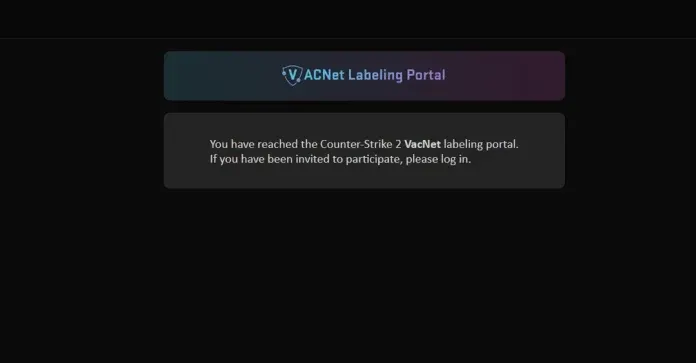
TalkEsport published this screenshot from the portal's initial rollout on August 11.
What changes in your Premier matches
Nothing immediate. The labeled data needs to accumulate, then retrain the model, then deploy. A wallhacker in your lobby today is unaffected.
The indirect signal is more interesting. Two structural anti-cheat changes in two weeks, the subtick bypass closure and then a systematic data-collection program, point toward a different posture than the scattered one-off patches CS2 shipped through most of 2025.
For now, the most direct feedback loop you have is checking whether players you have reported appear on the nohax.club CS2 ban list. That list tracks community-reported players whom Valve subsequently banned and tells you whether your reports are reaching the queue. Trust factor still determines matchmaking lobby quality. Check yours at nohax.club/cs2-trust-factor if recent sessions have felt consistently worse.
Who gets invited and when the pool grows
Valve has not published eligibility criteria. The portal UI includes an "Invite Reviewers" button that is not yet active, pointing toward a trust-network model where existing reviewers nominate others rather than Valve running a mass enrollment. Label quality stays controlled as the pool grows.
The 15,000 Premier points threshold circulating on Reddit is plausible but unconfirmed. Valve has named no rating floor, playtime cutoff, or account age requirement. The silence makes sense if Valve wants reviewers selected on behavioral signals rather than whatever number players figure out and try to reach.
For most players, the portal is invisible. A public-facing labeling system with documented reviewer instructions is a different approach than anything Valve has shipped on CS2 anti-cheat before. Whether the retrained VACNet model that eventually deploys is better is unknown from the outside. Valve has published no timeline. Building this publicly is the most anti-cheat transparency CS2 has offered in three years.