CS2
Counter-Strike 2's Rush mode handed out competitive cooldowns for one stray bullet. Valve patched it in 48 hours.
· 5 min read
Valve's Rush mode ran 5v5 team damage kick rules in 3v3 arenas and handed out competitive cooldowns for stray bullets. What the Sept 24 fix means.
Valve turned friendly fire on inside a 3v3 mode built out of rooms roughly the size of a stairwell, then left the old team damage auto-kick running underneath it. You can guess how that went.
Rush shipped on September 22, 2026 at 23:37 UTC as part of the Rush Hour update. By September 24 Valve had already rewritten the kick rules. The patch note is one line: "Adjusted rules for determining when to kick players due to team damage."
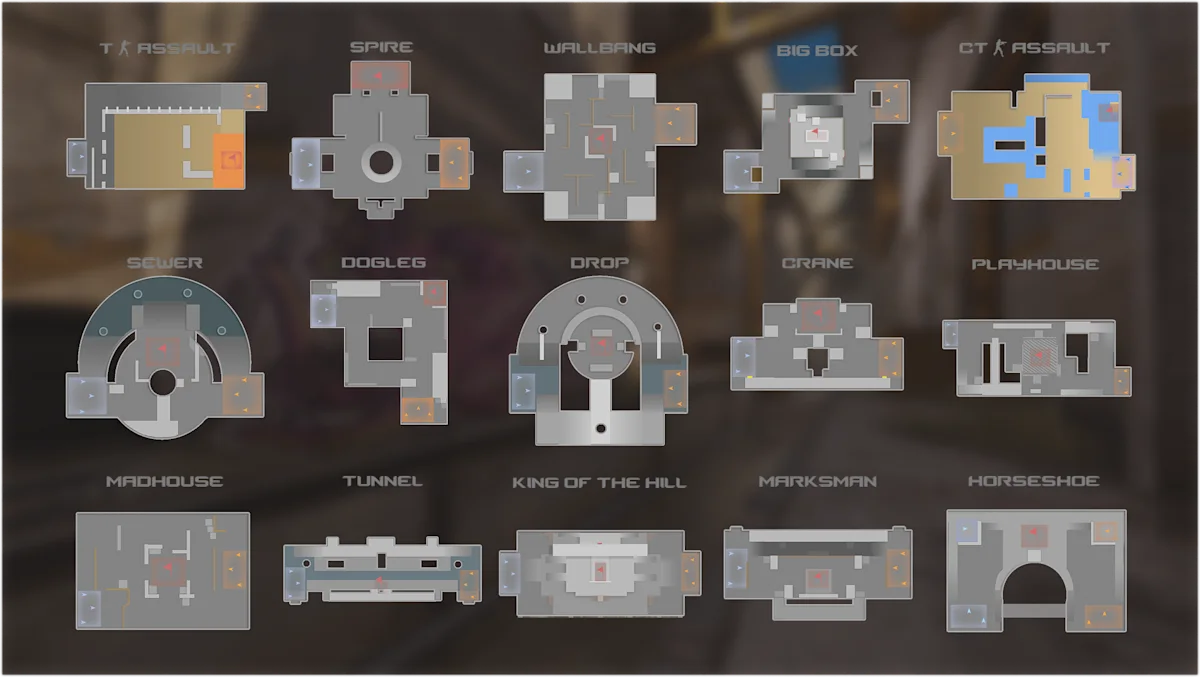
Valve published that image with the Rush Hour announcement on counter-strike.net. Look at how much room three people have.
Two days in, players were eating cooldowns
FPSHUB covered it on September 24 under the headline "Accidental teamkill in Rush nets you an instant competitive cooldown." The player in that report described a 30-minute competitive cooldown after one bullet clipped a teammate at round start, and said they had never been kicked for team damage since CS2 launched.
That matches how the system has always worked. Valve has never published the thresholds. The numbers the community settled on years ago, and still repeats in Steam forum threads dating back to 2023, are roughly 300 cumulative points of team damage, three team kills, or a team kill at the very start of a round fast enough that it can only be deliberate. Those were tuned for 5v5 defusal, where 300 team damage across a half really is a bad night.
Drop them into a Rush arena and the math breaks. Three players, one corridor, rounds that can end in twenty seconds. A single HE into a stacked doorway plus one spray through a teammate's shoulder puts you near 300 without anyone griefing. The round-start rule ages even worse: in Rush you are in contact almost immediately, so team damage in the first seconds is ordinary rather than suspicious.
Valve caught part of this on day one. The September 23 note already carved out an exception so the countdown-after-elimination timer "does not activate in cases where an entire team dies to suicides, team kills, and/or disconnects." They were patching team-kill edge cases before most people had finished ten matches.
The part Valve didn't write down
The September 24 note says the rules were adjusted. It never says what they were adjusted to. It says nothing at all about the cooldowns already sitting on accounts from the September 22 to 24 window.
It also skips the question that actually matters to you. timesaver.gg's Rush breakdown lists "whether Rush penalties affect competitive/Premier matchmaking" as one of the things Valve has simply never documented. The players who got hit answered it anyway. What they reported was a competitive cooldown, not a Rush-only one.
Why 30 minutes is not 30 minutes
This is the part still worth your attention a week later.
Valve's Competitive Cooldown Levels page describes a ladder rather than a flat penalty. Level 1 is 30 minutes. Level 2 is 2 hours. Level 3 is 24 hours. Level 4 is a full week, and accounts can climb past level 4. A week of clean play knocks you down one level.
So a Rush accident on September 23 did not cost anyone half an hour. It parked their account at cooldown level 1 for about seven days. If your power flickers during a Premier match that Saturday, the abandon costs two hours instead of thirty minutes, and the next one costs a day. Griefing cooldowns run on a harsher track entirely; players have posted nine-day grief bans on the Steam forums.
Your Premier rating itself is untouched. You just can't queue, which for anyone playing three or four Premier games a week is the more irritating outcome.
Whether any of this feeds trust factor is a question Valve won't answer directly, and I'm not going to pretend otherwise. Conduct signals have long been part of that calculation, and a cooldown is about as loud a conduct signal as the system produces. The inputs people have actually confirmed are collected at nohax.club/cs2-trust-factor.
What I'd actually do this week
Took a cooldown between September 22 and 24? Count seven days forward from that date and treat the gap as probation. No abandons, no queueing a Premier game you might have to walk away from.
Hold utility in Rush. An HE thrown into a room your teammate is standing in behaves nothing like the same nade on Mirage, because there is barely any distance for the damage to fall off over.
Watch the round-start spray in particular. That is the trigger that caught most people, and the adjusted rule still exists in some form.
Don't warm up in Rush before a Premier session. One clumsy round in a mode with no rating attached should not be able to lock you out of the mode that has one.
The reporting flow matters in the other direction too. Rush gives deliberate team-damagers a fast way to farm kicks on strangers, and Valve does eventually act on that pattern. Reported accounts that later picked up bans are listed at nohax.club/cs2-ban-list if you want to see whether the person who ruined your evening got anything.
The thing that still bugs me
The fix was fast and it was correct. The decision behind it is what I keep chewing on. Valve built a mode with friendly fire, set it in randomly chosen rooms where teammates are unavoidably in each other's line of fire, and wired it straight into a penalty system calibrated for a different game, with no separate Rush cooldown tier. Two days of players catching strikes for accidents is a small cost. It was also an entirely predictable one.
The loose end is those cooldowns from the launch window. Nobody at Valve has said whether they get cleared. Based on how CS2 usually handles this, I would not hold my breath.