CS2
Counter-Strike 2 Killed the Sticker Capsule and Replaced It With a Live Stock Market
· 4 min read
Valve killed CS2's sticker capsule at Cologne 2026 and replaced it with dynamic-priced tokens, Souvenir-O-Matic, and a community that can't agree.
The sticker capsule is dead. No more buying a Cologne capsule for $2.49 and hoping your random pull is worth anything. No more opening twelve papers to get one foil. Valve quietly buried the system that defined major economics since 2014 and replaced it with something the community still hasn't agreed on: a live, demand-driven token shop where sticker prices move in real time and the full set of 100 top stickers currently costs **$19,447**.
That's not a typo.

Photo via HLTV's IEM Cologne 2026 coverage.
How the New Shop Actually Works
Starting with IEM Cologne 2026, stickers live inside a Major Shop powered entirely by **tokens**. 100 tokens cost $0.99. You spend those tokens to buy individual stickers at whatever the market rate is at that moment — no randomness, no capsules, no mystery.
The prices are set by demand. When hundreds of players pile in to buy NiKo's Gold autograph, the token cost for that sticker climbs. When interest fades, it drops. The specific mechanics behind each price movement aren't shown to buyers — you can see the 7-day low and high displayed in the shop, but Valve doesn't publish supply data or transaction volume.
By the numbers:
100 tokens = $0.99
NiKo's Gold autograph peaked above 55,000 tokens (~$545) on opening day
The single most expensive sticker in the shop hit **$1,522**
Buying one of each of the 100 most expensive stickers costs **$19,447**
772 total stickers across Paper, Foil, Holo, and Gold variants
One built-in protection: if a sticker you buy drops more than 25 tokens within 24 hours, Valve automatically refunds the difference. It's a partial floor — but only for 24 hours.
Of the revenue, 50% is shared with teams and organizers, distributed by Valve Regional Standings while the major is live. Top-ranked teams receive 2.85% of sticker revenue; the bottom two receive 0.72% each. After the major ends, distribution flips to reflect final tournament placement.
The Souvenir-O-Matic Changes Everything
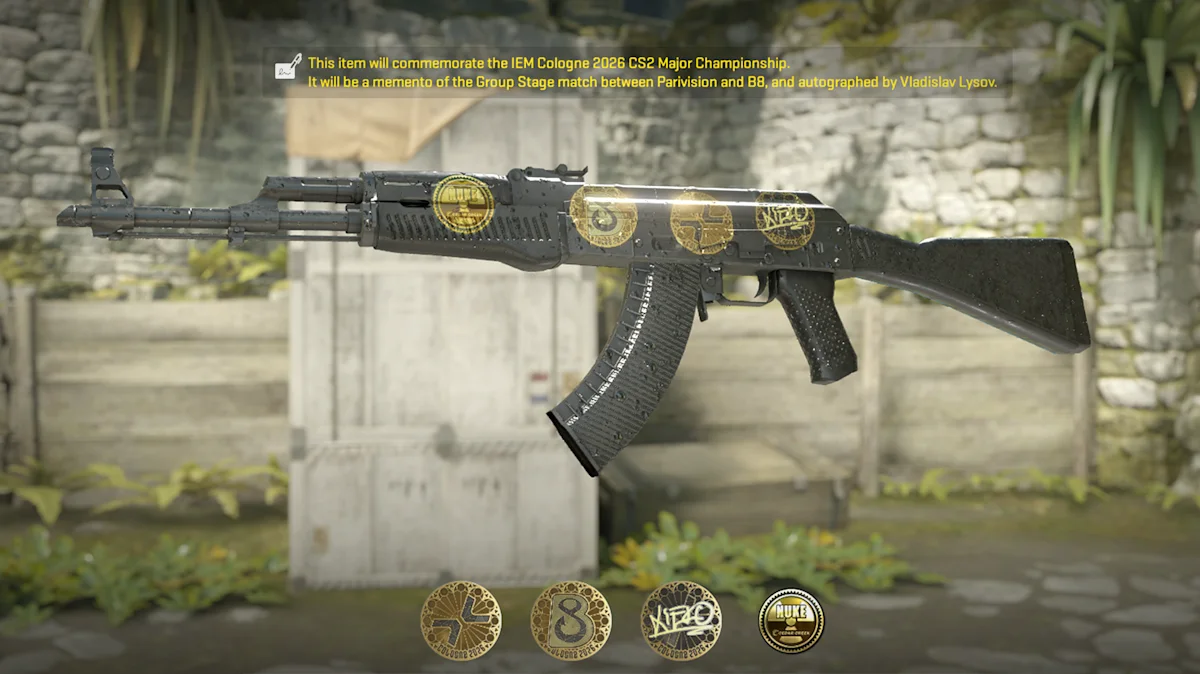
The other half of this overhaul is the **Souvenir-O-Matic**, and it's genuinely new. Traditional souvenir packages — random drops tied to watching matches — are gone. The Budapest 2025 packages were the last ones Valve will ever release.
Instead, you bring your own weapon.
Screenshot via the official Cologne 2026 CS2 update on Steam.
The process: pick any Normal-quality skin from your inventory — anything from a gray Consumer-grade pistol to a Factory New Covert rifle — then select a completed match from Cologne 2026 and a specific player. Pay in tokens. The Souvenir-O-Matic stamps four gold stickers onto your skin: two team logos, one player autograph, and one exclusive map sticker that exists nowhere else in the game. The result is a Souvenir-quality weapon built around a moment you actually chose.
The craft is permanent and irreversible. Any existing stickers on the weapon are removed before the conversion. Valve lets you preview the result before committing — the only mercy in a system where a mistake costs real money. Souvenir skins made through the Souvenir-O-Matic are also now eligible for Trade-Ups, something that was never possible with the old random packages.
After Falcons Won
When Falcons swept FURIA 3-0 in the Grand Final on June 24, Valve added **Champions Autograph stickers** for all five winning players. These are separate from standard player autographs — they carry the Champion designation and come in Foil and Gold variants. Alongside those, Valve dropped **Highlight Souvenir Charms** tied to 10 memorable moments from each of the tournament's six stages, plus a charm commemorating Falcons' trophy ceremony.
One notable absence: **karrigan**. He was registered as a Falcons substitute but didn't play a single map at Cologne. Under Valve's rules, non-playing subs receive no in-game commemoration — no Champion sticker, no cut of sticker revenue. He was there. The shop doesn't know it.
The Community Is Split
The reaction has been loud and hasn't settled. Streamer fl0m called the new system "a total money grab" with dynamic prices "way too high." Content creator Arrow titled his breakdown "How Valve Ruined Major Stickers Culture," arguing Cologne marked the moment sticker culture shifted from fandom to financial speculation.
The counter-argument is simple: the old system was gambling. Random capsule openings meant most buyers walked away with a stack of Paper stickers they never wanted, endlessly chasing a Gold they'd likely never get. The new shop is expensive, but it's transparent — you know exactly what you're paying and you receive exactly what you buy.
The Steam community boards have an active thread asking whether the pricing is being manipulated — cheaper stickers that peaked early are now sitting on the Steam Market at a fraction of their shop price while the popular ones keep climbing. Nobody has a clean answer, which tells you something.
The capsule was a lottery. The Major Shop is a market. Both cost money — one just hid it better.